
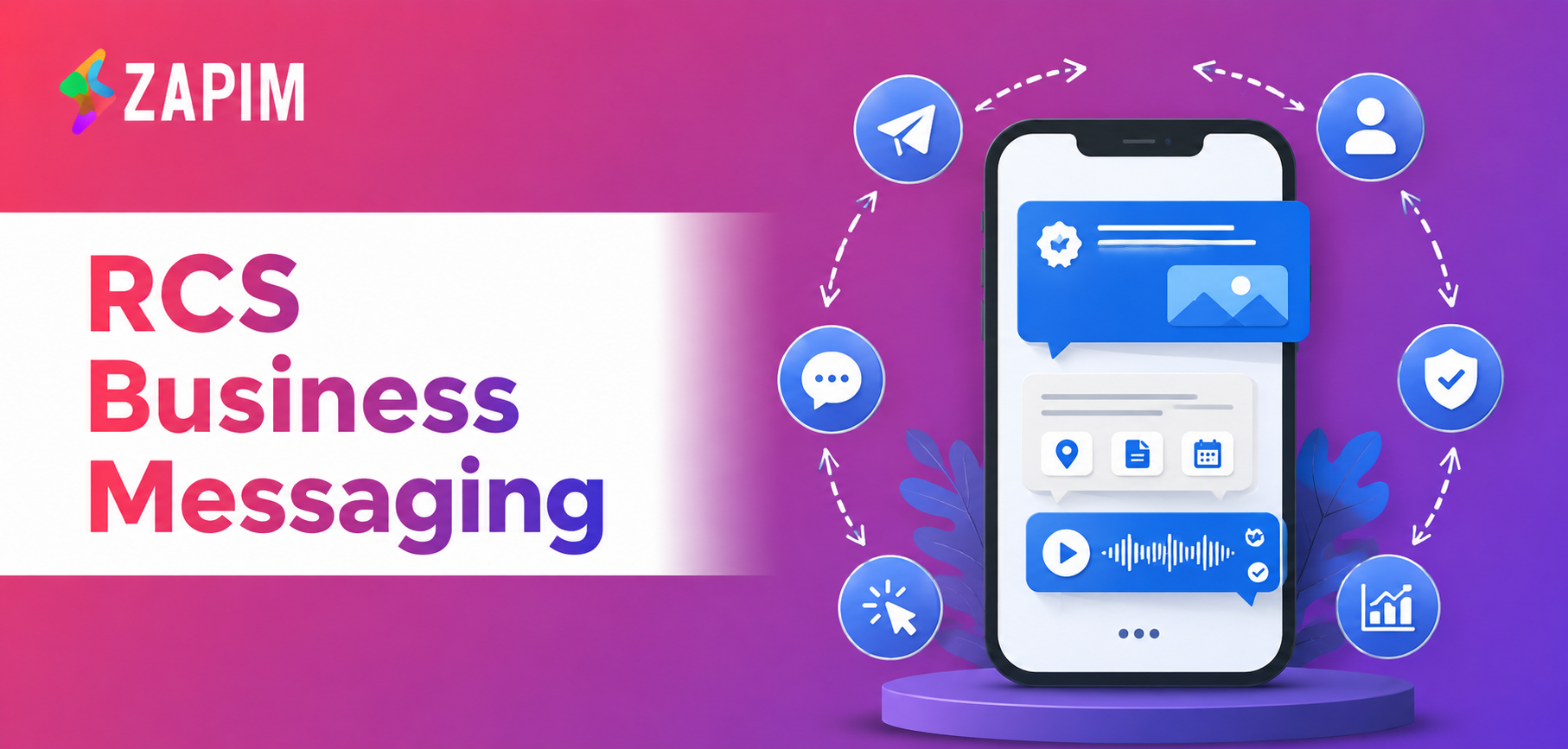
RCS Business Messaging: Features, Benefits & SMS Comparison
SMS has long been one of the most reliable ways for businesses to communicate with customers. From one-time passwords and payment alerts to appointment reminders and delivery updates, it remains fast, familiar and widely accessible.
However, customer expectations have moved beyond receiving plain text and clicking an external link.
Today’s customers are accustomed to visual, interactive and personalised digital experiences. They want to browse products, compare options, track orders, book appointments and connect with support without moving across multiple applications.
This is where RCS business messaging creates a new opportunity.
Rich Communication Services, or RCS, transforms the default messaging inbox into a more visual and interactive engagement channel. It allows businesses to send verified, branded messages containing images, videos, rich cards, carousels, suggested replies and action buttons.
In other words, RCS can offer customers an app-like experience without app downloads.
Rather than replacing SMS entirely, RCS builds on its accessibility while providing the richer experiences required by modern customer engagement strategies.
What Is RCS Business Messaging?
RCS stands for Rich Communication Services, a modern messaging standard designed to provide more advanced capabilities than traditional SMS and MMS.
For businesses, RCS enables interactive conversations within a supported customer’s default messaging application. A message can contain text, media, PDFs, rich cards, suggested replies and suggested actions instead of relying only on plain text and external links.
For example, a retailer can display several products through a swipeable carousel. A logistics company can send a delivery update with “Track Order” and “Reschedule Delivery” buttons. A travel company can share booking details with options to check in or add the trip to the customer’s calendar.
The customer does not need to download a separate brand application or learn a new interface. The interaction takes place within a messaging environment they already recognise.
Also Read: Best RCS Business Messaging Providers India (2026 Guide & Comparison)
RCS vs SMS for Business
Traditional SMS remains highly effective for short and urgent communication. However, its text-based format can limit what businesses can show customers and what customers can do within the message.
The difference between RCS vs SMS for business becomes clearer when a customer needs to take action.
|
Capability |
Traditional SMS |
RCS Business Messaging |
|
Content format |
Primarily text and links |
Images, videos, rich cards and carousels |
|
Brand identity |
Limited sender information |
Verified business name, logo and profile |
|
Customer response |
Typed replies or external links |
Suggested replies and action buttons |
|
Product discovery |
Usually redirects to a website |
Products can be displayed in the message |
|
Measurement |
Mainly delivery-focused |
Delivery, reads, replies and interactions |
|
Experience |
Functional and direct |
Visual, branded and conversational |
RCS does not make SMS irrelevant. Businesses can use RCS for richer customer journeys while maintaining SMS as a fallback when a customer’s device or network does not support RCS.
This combination helps brands improve the experience without sacrificing reach.
Five RCS Features Transforming Customer Engagement
1. Verified Sender Profiles Build Customer Trust
Customers are becoming increasingly cautious about messages from unfamiliar senders, especially when those messages include payment requests, account information or links.
A Verified Sender can Build Customer Trust by showing clear business information such as the company’s approved name, logo and verification indicator.
Unlike a message from an unknown number, a verified and branded profile helps customers recognise who is contacting them before they interact with the content. Google Messages, for example, displays the company’s name, logo and verification check mark in supported business conversations.
This makes branded business messaging particularly valuable for sectors such as banking, insurance, retail, travel and logistics, where trust directly influences whether a customer opens and acts on a message.
Verification should not be viewed as a decorative feature. It is an important part of creating recognisable and more trustworthy business communication.
2. Rich Media Makes Messages Easier to Understand
Plain text can communicate an offer, but a strong visual can make that offer easier to understand.
With RCS rich media support, businesses can use images, videos, GIFs, PDFs and product visuals to provide more context within the message itself.
A hotel can display available rooms instead of describing them in a paragraph. An automotive company can introduce a vehicle through video. A retailer can show a product, its price and its main benefit within one rich card.
Rich cards combine media, text and suggested actions in a single message, giving customers both the information and the next step.
The objective is not to add visuals to every interaction. Businesses should use rich media when it makes information clearer, more engaging or easier to act upon.
3. Suggested Replies and Action Buttons Reduce Friction
Customers often abandon a journey because it requires too many steps.
Suggested replies and action buttons allow businesses to present simple options such as:
- Track My Order
- Book an Appointment
- View Available Plans
- Find a Store
- Speak to Support
Instead of typing a response or searching for the appropriate webpage, the customer can select the most relevant action.
These buttons can also support automated customer journeys. Selecting “Book an Appointment,” for example, can trigger available dates, followed by time slots and a booking confirmation.
Clear and relevant suggestions are important. Google recommends keeping suggested actions concise and directly connected to the current conversation so customers are not overwhelmed by unnecessary choices.
4. RCS Carousels and Rich Cards Improve Product Discovery
RCS carousels and rich cards allow businesses to present multiple products, services or plans within one organised message.
Each card can include:
- A product image
- A title and short description
- Price or offer information
- A relevant call to action
A fashion retailer can showcase a new collection. A travel company can display different holiday packages. A financial service provider can help customers compare plans.
This is more effective than sending several disconnected links because the customer can explore the available options before deciding where to go next.
Carousels can therefore turn a promotional message into a compact product-discovery experience.
5. Read Receipts Make Engagement More Measurable
Sending a message is only the first stage of a successful campaign. Businesses also need to understand what happens after delivery.
RCS can support delivery receipts, read receipts, customer responses and interactions with suggested actions. Businesses can use these signals to measure message delivery, reads, responses and the actions customers select.
This allows teams to assess:
- Whether customers opened the message
- Which buttons attracted the most engagement
- Where customers left the conversation
- Which journeys resulted in a conversion
- How quickly customers responded
These insights can help businesses refine visuals, calls to action, message timing and conversation flows.
RCS alone does not guarantee higher conversions. Campaign performance will still depend on the relevance of the message, audience targeting, timing, offer and overall journey. However, it provides businesses with more tools to understand and improve customer engagement.
Also Read: RCS vs SMS: What Is the Difference & Which Is Best in 2026?
The Zero-Download Advantage
Many businesses invest in mobile applications but struggle to convince customers to download and regularly use them.
RCS reduces this barrier by offering an app-like experience without app downloads.
Customers can view rich content, browse products, select actions and continue a conversation inside their supported native messaging application.
This is particularly valuable for businesses that:
- Do not have a dedicated mobile application
- Engage customers who purchase occasionally
- Want to reach first-time buyers
- Need to deliver time-sensitive information
- Want to reduce the steps required to complete a task
RCS does not replace every function of a mobile application. Instead, it brings the most useful actions into the customer’s existing messaging journey.
How Businesses Can Use RCS Across the Customer Journey
RCS is not limited to promotional campaigns. It can support customers before, during and after a purchase.
Customer acquisition
Businesses can use RCS marketing campaigns to introduce products, share personalised offers and capture customer interest through suggested replies.
Instead of sending every recipient to the same landing page, the conversation can continue according to the option selected by the customer.
Conversion
RCS can support high-intent interactions such as cart recovery, appointment booking, subscription renewal and store discovery.
For example, an abandoned-cart message can show the product left behind and include options to “Complete Purchase” or “View Similar Products.”
Reducing the number of steps between the message and the desired action can help businesses boost conversion rates with RCS.
Post-purchase service
After a transaction, businesses can send order confirmations, delivery updates, booking information, digital receipts and service reminders.
A customer may also be able to confirm, change or reschedule an order directly through the conversation.
Retention
Brands can use RCS for loyalty updates, replenishment reminders, personalised recommendations, feedback requests and renewal alerts.
These interactions can be more relevant and actionable than a generic promotional SMS.
RCS Use Cases Across Industries
In retail and e-commerce, RCS can support product launches, personalised recommendations, cart recovery and sale campaigns.
Travel and hospitality businesses can use it for booking confirmations, itinerary updates, check-in reminders and upgrade offers.
Logistics companies can provide shipment tracking, delivery windows and rescheduling options without requiring customers to contact a call centre.
Banks and financial service providers can send branded payment reminders, application updates and service notifications through recognisable business profiles.
Across these industries, the value of RCS comes from combining information and action in the same interaction.
Also Read: SMS Error Code 113: Why Your Approved Template Is Still Getting Rejected
Why RCS Matters in 2026
RCS is becoming an important part of mobile marketing trends in 2026 as businesses move towards more conversational, measurable and connected customer communication.
The GSMA’s Universal Profile provides an industry-agreed set of RCS features designed to support more consistent implementation across devices and operators. Universal Profile 4.0, published in 2026, introduced further messaging enhancements, including richer text capabilities, improved media experiences and support for streaming video in business rich cards.
These developments reflect wider changes in customer engagement:
- Customers expect faster, more interactive service.
- Businesses want better visibility into campaign performance.
- Verified brand communication is becoming more important.
- AI and automation are making conversations more personalised.
- Brands are connecting marketing, service and transactional communication.
RCS supports these priorities by turning messaging from a one-way notification channel into a more complete customer engagement environment.
How to Implement RCS Messaging
Businesses should begin with a specific customer problem rather than trying to use every RCS feature at once.
First, identify a journey where interactivity can reduce friction, such as delivery rescheduling, appointment booking or cart recovery.
Next, define measurable objectives. These could include increasing completed bookings, reducing support calls, improving response rates or recovering abandoned purchases.
The conversation should then be mapped from beginning to end. This includes the opening message, rich media, suggested responses, follow-up actions and escalation to a human agent when required.
Businesses should also connect their RCS solution with relevant systems such as CRM, e-commerce, customer support and order-management platforms.
Finally, an SMS fallback journey should be prepared for customers who cannot receive the RCS version. This ensures that essential communication still reaches the customer.
Also Read: From Google Search to RCS Chat: How Zapim Turns Search Intent into Real Conversations
Build Connected RCS Journeys With Zapim CPaaS
Implementing RCS involves more than creating an attractive message. Businesses also need to manage sender verification, APIs, automation, analytics, customer data and fallback communication.
Zapim CPaaS helps businesses bring these capabilities together within one scalable communication platform.
Through Zapim’s RCS API, businesses can create branded campaigns, rich-media notifications, product carousels, quick replies and two-way customer conversations. Zapim also provides automation, engagement analytics, API integration and infrastructure designed to manage high messaging volumes.
Through its Unified Omnichannel Suite, Zapim connects RCS with communication channels such as SMS, WhatsApp, voice and email. This allows businesses to build coordinated journeys rather than managing each channel as a separate interaction.
With the right strategy and technology, businesses can use RCS to create communication that is not only more engaging but also more useful, measurable and connected.
Moving Beyond Plain-Text Customer Communication
SMS will continue to play an essential role in business communication. Its accessibility and simplicity make it valuable for urgent and straightforward updates.
RCS builds on this foundation by adding the interactivity required for more advanced customer journeys.
Verified Sender profiles help businesses build customer trust. Rich media makes information easier to understand. Carousels improve product discovery, while suggested replies and action buttons help customers move from interest to action.
Most importantly, RCS provides an app-like experience without app downloads, allowing businesses to create richer interactions inside a channel customers already use.
For brands looking to modernise customer engagement, RCS is not simply a better-looking version of SMS. It is an opportunity to make every message more recognisable, actionable and connected.
Ready to move beyond plain-text SMS? Explore how Zapim CPaaS can help you build verified, interactive and automated RCS customer journeys through a Unified Omnichannel Suite.
Conclusion
SMS isn't going anywhere — its simplicity and universal reach still make it the right tool for short, urgent communication. But as customer expectations shift toward visual, interactive, and app-like experiences, RCS gives businesses a way to meet that expectation without asking customers to download anything new. Verified sender profiles build trust before a message is even opened, rich media and carousels make offers easier to understand and compare, and suggested replies turn passive notifications into two-way conversations that move customers closer to action. The businesses that benefit most from RCS won't be the ones that adopt every feature at once — they'll be the ones that start with a single high-friction journey, like delivery rescheduling or cart recovery, and build outward from there, with SMS as a reliable fallback. As Universal Profile 4.0 pushes RCS capabilities further in 2026, brands that treat messaging as a connected, measurable engagement channel — rather than a one-way broadcast — will be better positioned to convert attention into action. Platforms like Zapim CPaaS make that transition easier by bringing RCS, SMS, WhatsApp, voice, and email together into one coordinated customer journey.
Frequently Asked Questions
Q1 What is RCS business messaging?
RCS business messaging allows companies to send branded and interactive messages containing rich media, cards, carousels, suggested replies and action buttons through supported messaging applications.
Q2 How is RCS different from SMS?
SMS primarily supports text and links, while RCS supports verified profiles, visual content, interactive actions and more detailed engagement measurement.
Q3 Do customers need to download an application?
No separate brand application is required. Customers receive eligible RCS messages through a supported messaging application on their device.
Q4 What happens when RCS is unavailable?
Businesses can configure SMS or another communication channel as a fallback so the customer still receives the essential information.
Q5 How does Zapim support RCS messaging?
Zapim provides RCS APIs, branded messaging features, automation, analytics, integrations and omnichannel communication capabilities through its CPaaS platform.