
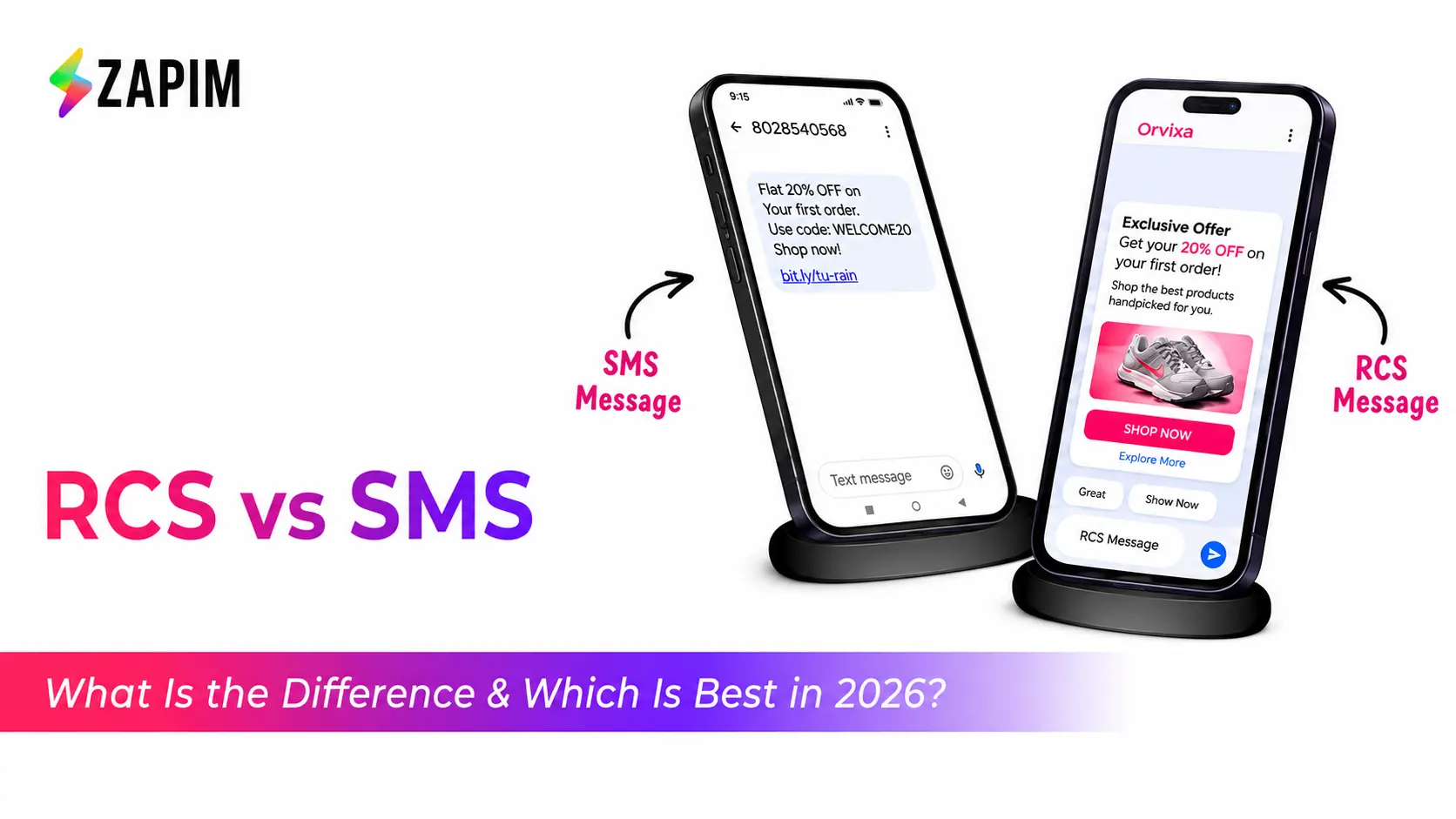
RCS vs SMS: What Is the Difference & Which Is Best in 2026?
Quick Answer: RCS vs SMS at a Glance
|
RCS |
SMS |
|
|
Full form |
Rich Communication Services |
Short Message Service |
|
Media |
Images, video, carousels, documents |
Plain text only |
|
Sender identity |
Verified brand profile with logo |
Phone number or short code |
|
Read receipts |
Yes |
No |
|
Interactive buttons |
Yes |
No |
|
Internet needed |
Yes |
No |
|
Character limit |
No practical limit |
160 characters |
|
Analytics |
Delivery + read rate + click-through |
Delivery only |
|
Best for |
Campaigns, engagement, conversions |
OTPs, alerts, universal reach |
Bottom line: RCS is the upgraded, app-like version of SMS, it works inside the phone's native messaging app with no download needed. SMS is plain text, universally compatible, and still essential for specific use cases like OTPs and transactional alerts.
What Is an RCS Message?
RCS (Rich Communication Services) is a next-generation messaging standard developed by GSMA to replace SMS. It delivers interactive, branded, media-rich messages directly to a phone's default messaging app, no separate app installation required.
Key Facts About RCS
- Delivered via Google Messages (Android) and Apple Messages (iOS 18+)
- Supported by all major telecom operators — including Jio, Airtel, BSNL, and Vi in India
- Backed by the GSMA standard and Google's RCS Business Messaging (RBM) framework
- Global user base: 2 billion+ monthly active users (2026)
What an RCS Message Can Contain
|
Content Type |
Examples |
|
Rich media |
High-resolution images, short videos, audio |
|
Interactive carousels |
Swipeable product cards, offers, menus |
|
Action buttons |
Buy Now, Track Order, Call Us, View Map |
|
Quick replies |
Pre-set customer response options |
|
Documents |
PDFs, boarding passes, invoices |
|
Verified sender info |
Business logo, brand name, verified checkmark |
Why RCS Is Different from Other Messaging Apps
RCS does not require your customer to install anything. It works inside the same app they already receive SMS on, which means zero friction and no opt-in barrier beyond DLT consent. The experience looks like WhatsApp or iMessage, but it arrives on the standard messaging app already on every phone.
What Is SMS?
SMS (Short Message Service) is a plain-text messaging protocol that has powered mobile communication since 1992. It runs over cellular networks, no internet, no smartphone, no app needed.
Key Facts About SMS
- 160-character limit per message (concatenated for longer texts)
- Works on every mobile device, feature phones, smartphones, and any OS
- Requires only a cellular signal, no data or Wi-Fi
- Near-instantaneous delivery even in low-signal areas
- Sender shown as number, short code, or registered DLT header (India)
Where SMS Excels
- Universal reach — 100% of mobile users can receive it
- No internet dependency
- Fastest channel for OTPs and time-critical alerts
- Works in low-connectivity and rural regions
- Lower per-message cost
Where SMS Falls Short
- No images, videos, or any media
- No interactive buttons or calls to action
- No read receipts or engagement tracking
- No brand verification — customers cannot confirm sender identity
- No click tracking or conversion analytics
RCS vs SMS: Full Feature Comparison
|
Feature |
RCS |
SMS |
|
Media support |
Images, video, audio, carousels, PDFs |
Plain text only |
|
Character limit |
No practical limit |
160 characters |
|
Sender verification |
Verified brand profile with logo |
Number / short code/header |
|
Read receipts |
Yes |
No |
|
Delivery receipts |
Real-time |
Basic |
|
Internet required |
Yes (data or Wi-Fi) |
No |
|
Interactive buttons |
CTA, quick reply, map, call |
No |
|
Two-way messaging |
Yes |
Limited |
|
Automatic fallback |
Falls back to SMS if unsupported |
N/A |
|
Campaign analytics |
Delivery + read rate + CTR + conversion |
Delivery rate only |
|
Per-message cost |
Higher |
Lower |
|
DLT compliance (India) |
Required |
Required |
|
Branding |
Full brand identity |
None |
|
Spam/phishing risk |
Low (verified sender) |
High (unverified numbers) |
|
Supported devices |
Android native + iOS 18+ |
All phones |
3 Differences That Matter Most
1. Verified Sender: the trust signal businesses can't ignore
In India, phishing via unverified SMS is a serious and growing problem — fake bank messages, fraudulent OTPs, brand impersonation scams. An RCS message arrives with your verified company logo and name, removing all ambiguity. For BFSI and healthcare brands, this is not a minor feature. It is the single biggest reason customers open and act on the message.
2. Automatic Fallback: no reach compromise
The most common concern about RCS: "What if some of my customers can't receive it?" With Zapim's platform, the system automatically detects whether each recipient's device supports RCS. If not, the message is converted and delivered as SMS — instantly, without manual action. You reach 100% of your list. Some just get a richer experience than others.
3. Analytics Depth: the difference between guessing and optimising
SMS confirms delivery. RCS tells you delivery status, open time, read confirmation, which button was tapped, and how long after receiving the message, action was taken. That is the data layer that makes iterative campaign improvement actually possible.
RCS vs SMS: Engagement & Performance Data
|
Metric |
RCS |
SMS |
|
Average open rate |
70–90% |
45–60% |
|
Average click-through rate |
15–35% |
2–5% |
|
Conversion rate vs SMS |
Up to 3x higher |
Baseline |
|
Customer trust score |
Higher (verified sender) |
Lower |
|
Response rate (two-way) |
Significantly higher |
Low |
Zapim platform data: Brands running RCS campaigns through Zapim average 70% higher conversion rates compared to equivalent SMS campaigns. The biggest driver is the combination of verified identity and an interactive CTA, together they move customers from reading to acting.
What Is RCS Message Used For? — Business Use Cases
1. Promotional Campaigns
- Product carousels with images, pricing, and Buy Now buttons
- Seasonal sale campaigns with visual offers
- New collection launches with swipeable cards and direct purchase links
2. Transactional Notifications
- Order confirmations with product image and live tracking button
- Delivery updates with map link to track courier location
- Payment confirmations with verified sender — customers trust it instantly
3. Cart Recovery
- Show the abandoned product image directly in the message
- Include a single Complete Purchase button
- Add a limited-time offer or discount within the same message thread
4. Customer Support
- Quick-reply buttons guide customers (Track Order / Initiate Return / Speak to Agent)
- Route to chatbot or human agent within the same thread
- Resolve queries without the customer leaving their messaging app
5. Appointment & Booking Management
- Appointment reminders with Confirm / Reschedule / Cancel buttons
- Booking QR codes and venue map links embedded in the message
- Post-appointment feedback with one-tap rating options
6. Financial Alerts (BFSI)
- Transaction alerts with verified sender, no chance of impersonation
- Fraud warnings with immediate action buttons (Block Card / Report)
- EMI reminders with a direct payment link in the message
When to Use RCS vs SMS: Decision Guide
Choose RCS When:
- Your campaign needs images, videos, or product carousels
- You want customers to take action, tap, click, book, buy, from within the message
- Brand trust and sender verification matter (banking, healthcare, e-commerce)
- You are targeting smartphone users with data access
- You need engagement analytics beyond basic delivery confirmation
- You are running conversational or two-way messaging flows
Choose SMS When:
- You are sending OTPs, speed and universality are non-negotiable
- Your audience includes feature phone users or low-connectivity areas
- The message is purely informational, no action is needed from the recipient
- You need 100% guaranteed reach, no conditions or device dependencies
- Per-message cost is a hard constraint
Use RCS + SMS Together When:
- You want maximum reach AND maximum engagement simultaneously
- Running RCS as primary with automatic SMS fallback ensures every recipient gets the message, in the richest format their device supports
- This is the recommended approach for any business running serious omnichannel communication
RCS vs SMS: Industry-Specific Recommendations
|
Industry |
Recommended Channel |
Why |
|
Retail & E-commerce |
RCS primary, SMS fallback |
Product carousels, cart recovery, visual promotions |
|
BFSI |
RCS for alerts + SMS for OTPs |
Verified sender for trust; SMS ensures OTP speed |
|
Healthcare |
RCS for appointments, SMS for reminders |
Interactive confirm/reschedule + universal delivery fallback |
|
Travel & Hospitality |
RCS |
Boarding passes, QR codes, hotel check-in, real-time updates |
|
Logistics |
RCS + SMS |
Live tracking maps via RCS; delivery alerts via SMS |
|
Consumer Goods |
RCS |
Product launches, loyalty programmes, interactive catalogues |
|
Automobiles |
RCS |
Service reminders, test drive scheduling, vehicle health reports |
RCS in India: What Businesses Need to Know in 2026
RCS Network Availability in India
|
Telecom Operator |
RCS Support |
|
Jio |
Available |
|
Airtel |
Available |
|
BSNL |
Available |
|
Vi (Vodafone Idea) |
Available |
India has 820 million+ smartphone users in 2026, a large proportion on Android with Google Messages installed, meaning they are RCS-ready right now without any action needed on their end.
DLT Compliance for RCS in India
A common misconception: "RCS is new, so DLT rules probably don't apply yet."
That is incorrect. TRAI's DLT (Distributed Ledger Technology) framework applies to all commercial messaging in India, including RCS.
Before sending any RCS business message, the following steps are mandatory:
- Register the sender header on the DLT portal
- Pre-approve all message templates
- Maintain valid consent records for recipients
- Follow content guidelines for promotional and transactional message categories
Skipping DLT compliance results in delivery failures and regulatory risk, regardless of how rich or interactive the message is.
How Zapim Handles DLT for RCS
Zapim's DLT Assistance service manages the full compliance process:
- Sender header registration
- Message template pre-approval
- Ongoing compliance monitoring
- Operator coordination for smooth delivery
Businesses do not need to navigate the DLT portal themselves, Zapim handles it end to end.
How Zapim Powers RCS and SMS for Businesses
Zapim is an AI-powered CPaaS (Communications Platform as a Service). It gives businesses the infrastructure to run professional, scalable messaging across RCS, SMS, WhatsApp, Voice, and Email — from a single unified dashboard.
Zapim's RCS Features
|
Feature |
What It Does |
|
Verified sender profile |
Business name, logo, and contact info on every message |
|
Rich media builder |
Create image, video, carousel, and document campaigns |
|
Interactive buttons |
Quick reply, CTA, URL, map, call — fully configurable |
|
Live device preview |
See exactly how the message renders before it sends |
|
Automatic SMS fallback |
Switches to SMS if device does not support RCS |
|
Read and click analytics |
Real-time delivery, open, read, and tap-through tracking |
|
AI-powered send timing |
Sends each message when each recipient is most likely to engage |
|
DLT compliance |
End-to-end template registration and TRAI compliance management |
Zapim's SMS Features
|
Feature |
What It Does |
|
Bulk SMS |
High-volume promotional and transactional campaigns |
|
OTP delivery |
Fast, reliable one-time password delivery |
|
Transactional SMS |
Automated order, payment, and shipping alerts |
|
DLT registration |
Full TRAI DLT compliance — header and template management |
|
Smart routing |
Optimised delivery across operators for speed and reliability |
One Platform. All Channels.
Both RCS and SMS run inside the same Zapim dashboard, alongside WhatsApp, Voice, and Email. From one interface, businesses can:
- Segment the audience by device capability (RCS-capable vs non-RCS)
- Send RCS to smartphone users and SMS to the rest — automatically
- View unified analytics across all channels in one report
- Download campaign data in PDF, Excel, or CSV
500+ brands across India, in BFSI, retail, healthcare, travel, logistics, and consumer goods, run their business messaging through Zapim.
RCS vs SMS: Which Should Your Business Use in 2026?
The modern messaging strategy is not choosing between RCS and SMS—it is using both with intent.
- SMS is for Reliability: It remains the most globally compatible channel. Best for time-sensitive, low-data notifications, OTPs, and critical transactional alerts where guaranteed delivery is paramount.
- RCS is for Conversion: With native support on Android and iOS (18+), verified sender profiles, and rich media, RCS drives up to 3x better conversion rates than SMS. Best for marketing campaigns, promotions, cart recovery, and interactive customer actions.
The Dual-Channel Strategy
The ideal approach utilises RCS + SMS with automatic fallback. Businesses should send the rich RCS experience first, automatically falling back to SMS if the recipient’s device or network doesn't support it.
Impact on Indian Businesses
With full support from Jio, Airtel, BSNL, and Vi, India's RCS infrastructure is fully mature. While DLT compliance is mandatory, it is a process rather than a barrier. Platforms like Zapim streamline this transition by managing DLT compliance, automating channel routing, and providing unified analytics to maximise messaging ROI.
Frequently Asked Questions
Q1 What is an RCS message and how does it differ from SMS?
RCS (Rich Communication Services) is a messaging protocol that delivers interactive, media-rich messages through a phone's native messaging app, no app installation required. Unlike SMS, which is limited to 160 characters of plain text, RCS supports images, videos, carousels, interactive buttons, verified sender branding, and read receipts. GSMA developed it as the standardised successor to SMS.
Q2 Does RCS work on iPhone?
Yes. Apple added RCS support in iOS 18, released in late 2024. iPhone users on iOS 18 or later can send and receive RCS messages through the native Apple Messages app. This closed the last major gap in cross-platform RCS adoption; it now works across both Android and iPhone.
Q3 Is RCS more expensive than SMS?
Per the message, RCS is priced higher than SMS. However, RCS delivers significantly higher conversion rates; Zapim clients average 70% higher conversions on RCS versus equivalent SMS campaigns. The cost per acquisition on RCS is often lower than SMS as a result. The relevant measure is not cost per message but cost per outcome.
Q4 What happens if a recipient's phone does not support RCS?
Zapim's platform detects device capability for each recipient automatically. If the phone does not support RCS, an older Android, has no data connection, feature phone, the message is immediately converted and sent as SMS. Every recipient gets the message. The format adjusts to what their device supports.
Q5 Is RCS available in India?
Yes. RCS is supported on all four major Indian telecom networks: Jio, Airtel, BSNL, and Vi. DLT compliance under TRAI's framework is mandatory for RCS messaging in India, the same as SMS. Zapim's DLT Assistance service manages end-to-end compliance for businesses.
Q6 Can RCS replace WhatsApp for business messaging?
They serve different strengths. RCS is native, no app install, works on the default messaging app, best for first-contact campaigns and broad outbound messaging. WhatsApp has a large opted-in user base and stronger two-way conversation features. Most businesses use both: RCS for branded outbound campaigns, WhatsApp for ongoing customer conversations. Zapim supports both channels from one platform