
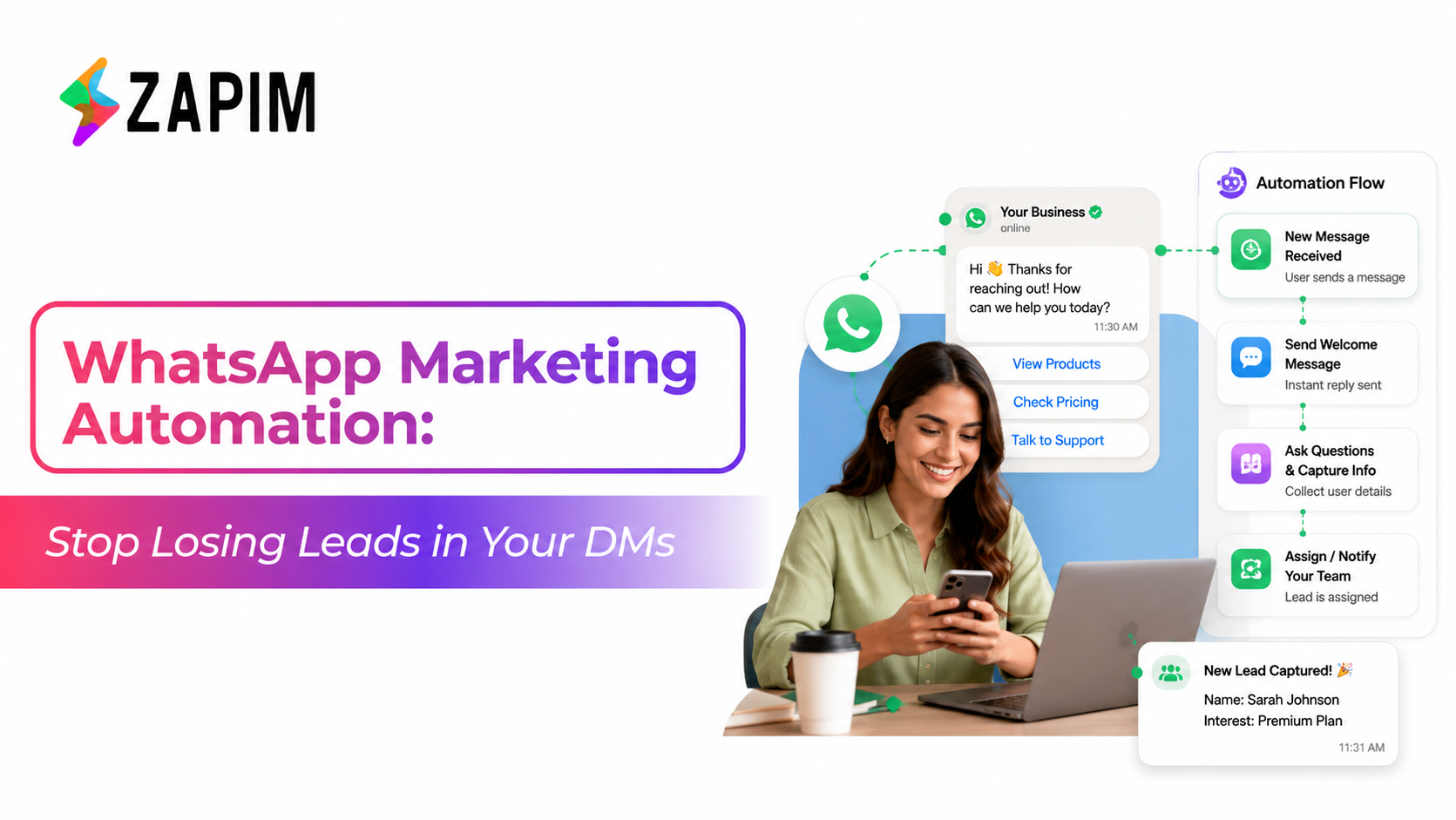
WhatsApp Marketing Automation: Stop Losing Leads in Your DMs
Picture this. A customer sees your product on Instagram, taps "message us," and instead of waiting six hours for a reply, gets an instant response with pricing, a catalogue link, and a payment option, all inside WhatsApp. No app-switching. No lost leads. No overworked support team scrambling through five different inboxes.
That's not a future scenario. That's what's already happening for brands that have figured out WhatsApp marketing automation, and it's exactly what we build at Zapim.
If you've been running your Instagram DMs, Facebook Messenger, and WhatsApp as three separate universes, you're leaving money on the table. Let's talk about why merging them is no longer optional, and how you can do it without hiring an entire tech team.
The Problem Nobody Talks About: Fragmented Conversations
Here's something most marketing blogs won't tell you straight: customers don't care which platform they used to find you. They care about getting an answer.
A shopper browses your Facebook ad on their lunch break, asks a question in the comments, forgets about it, then messages your Instagram page that evening asking the same thing. By the time your team replies (if they reply at all), the shopper has already checked out a competitor. This happens thousands of times a day across businesses that treat each platform like an island.
Social media to WhatsApp integration solves this by giving every channel one destination: a single WhatsApp thread where the conversation, the context, and the customer history all live together.
What Exactly Is WhatsApp Marketing Automation?
In plain terms, it's using tools and workflows that let WhatsApp send messages, respond to queries, qualify leads, and nurture customers without a human typing every single reply.
But the real magic happens when you stop thinking of WhatsApp as a standalone app and start treating it as the command centre for every other platform your audience uses. That means:
- A comment on your Instagram post automatically triggers a WhatsApp opt-in message
- A Facebook lead form submission drops the person straight into a WhatsApp drip sequence
- A "Click to WhatsApp" ad on Meta sends users into a pre-built automated flow instead of a blank chat screen
- Abandoned cart reminders, order confirmations, and shipping updates fire off on WhatsApp instead of getting buried in an email inbox
This combination, automation plus cross-platform integration, is what separates brands getting 40% response rates from brands still sending mass broadcasts that go straight to "Archived."
Why WhatsApp Is the Channel Worth Building Around
Email open rates hover somewhere around 20% on a good day. WhatsApp messages get opened by the vast majority of recipients, often within minutes. That single fact changes how you should be structuring your entire marketing funnel.
Add to that:
- Higher trust factor — people already use WhatsApp to talk to friends and family, so a business message feels more personal than a cold email
- Rich media support — send catalogues, videos, PDFs, location pins, and payment links in one thread
- Two-way conversation — unlike a broadcast email, customers can ask follow-up questions instantly
- Global reach — with billions of active users, there's a strong chance your exact customer is already on it daily
This is why WhatsApp Business API integration has quietly become one of the highest-ROI investments a growing brand can make.
How Social Media and WhatsApp Integration Actually Works
Let's break down the mechanics without the jargon overload.
1. Ad-to-Chat Connection
Meta's Click-to-WhatsApp ads let you run campaigns on Facebook and Instagram that open a WhatsApp chat the moment someone clicks. Instead of landing on a website form they'll probably abandon, they land in a conversation — which converts far better.
2. Comment and DM Automation
When someone comments a keyword under your Instagram post (say, "PRICE" or "INFO"), an automated sequence can trigger a WhatsApp opt-in request, pulling that lead out of Instagram's limited DM environment and into a channel where you can nurture them long-term.
3. CRM and E-commerce Sync
Connect your Shopify, WooCommerce, or CRM data to WhatsApp so that order updates, abandoned cart nudges, and post-purchase follow-ups happen automatically, based on real customer behaviour rather than guesswork.
4. Chatbot-Led Qualification
Automated flows ask a few quick questions, budget, product interest, and location, before handing the conversation to a human agent. Your team only steps in when it actually matters, saving hours every single day.
5. Broadcast Segmentation
Instead of blasting the same message to your entire list, automation tools segment audiences by behaviour (browsed but didn't buy, repeat customer, inactive for 30 days) and send tailored WhatsApp broadcasts to each group.
Where Zapim Fits Into This
We built Zapim because we kept watching businesses juggle five tools that didn't talk to each other — an ad manager here, a chatbot builder there, a separate CRM, and WhatsApp sitting disconnected from all of it.
Zapim brings social media to WhatsApp integration and WhatsApp chatbot automation under one roof, so a comment on Instagram, a lead form on Facebook, and a customer query on WhatsApp all flow into the same automated system. You set up the workflow once, capture the lead, qualify it, respond instantly, follow up if there's no reply, and it runs continuously, whether it's 3 PM or 3 AM.
No coding required. No stitching together five different apps with duct-tape workarounds. Just one dashboard where your entire conversational marketing engine lives.
Real Use Cases Worth Stealing
E-commerce brand: Cart abandoned on the website → automated WhatsApp message sent within 20 minutes with a discount code → 18% of abandoners recover into paying customers.
Real estate agency: Instagram reel gets a comment "interested" → automated DM invites them to WhatsApp → chatbot asks budget and location → qualified lead gets forwarded to a sales rep with full context already collected.
Local service business: Facebook lead ad captures a phone number → instant WhatsApp confirmation sent → appointment reminder sent 24 hours before the booking → no-show rate drops noticeably.
None of these require a large team. They require the right automation stitched to the right channels.
Best Practices Before You Hit "Launch"
A few things worth getting right from day one:
- Always get explicit opt-in. WhatsApp has strict policies, and unsolicited messages will get your number flagged or banned.
- Keep the first automated message short and human. Nobody wants to read a paragraph from a bot before they've even said hello.
- Give an easy exit. Let people type "STOP" or similar to opt out — it builds trust and keeps you compliant.
- Blend automation with real humans. Bots are great for the first 80% of a conversation. The last 20%, especially anything involving complaints or high-value deals, needs a person.
- Test your flows regularly. A broken automation is worse than no automation — customers notice fast when a bot loops or ignores their question.
The Mistakes That Quietly Kill Campaigns
Plenty of businesses jump into automation and wonder why results are flat. Usually, it comes down to:
- Sending generic broadcasts with zero segmentation
- Never updating chatbot flows after the initial setup
- Ignoring analytics, response rates, drop-off points, and conversion by source
- Treating WhatsApp like email instead of a real-time conversation channel
Automation isn't a "set it and forget it" tool. It's a system that needs the occasional tune-up based on what the data is actually telling you.
Conclusion
Your customers are already spread across Instagram, Facebook, and WhatsApp — that part isn't going to change. What can change is whether your business treats those platforms as disconnected inboxes or as one connected system working toward the same goal: faster responses, warmer leads, and conversations that actually convert.
That's the shift WhatsApp marketing automation makes possible, and it's the exact problem Zapim was built to solve. One integration, every platform feeding into it, and a lot fewer messages falling through the cracks.
If your team is still copy-pasting replies across four apps, it might be time to let automation carry that weight instead.
Frequently Asked Questions
Q1 Is WhatsApp marketing automation only for large businesses?
Not at all. Small businesses often see the biggest impact because a single automated flow can replace hours of manual replying, freeing up time that would otherwise go into answering the same five questions repeatedly.
Q2 Do I need the WhatsApp Business API or is the regular app enough?
The standard WhatsApp Business app works for very small volumes. Once you're running ads, integrating other platforms, or handling more than a handful of conversations a day, the official API (accessed through a provider like Zapim) is what you need for automation, broadcasts, and multi-agent support.
Q3 Will automated messages feel robotic to customers?
Only if they're written poorly. A well-designed flow feels like a fast, helpful response, not a robotic script. The tone and structure matter as much as the technology behind it.
Q4 Can I connect Instagram and Facebook to WhatsApp without any technical knowledge?
Yes, that's the whole point of using a platform like Zapim. The integrations are built to be set up through simple dashboards and guided flows, so you're not writing code or hiring a developer just to link your ad account to a chatbot.
Q5 How long does it take to see results after setting up automation?
Most businesses notice a difference in response times within the first week, since replies that used to take hours now happen instantly. Measurable gains in conversions and recovered sales usually show up over the first month, once you've had enough conversations to refine the flows and messaging.