
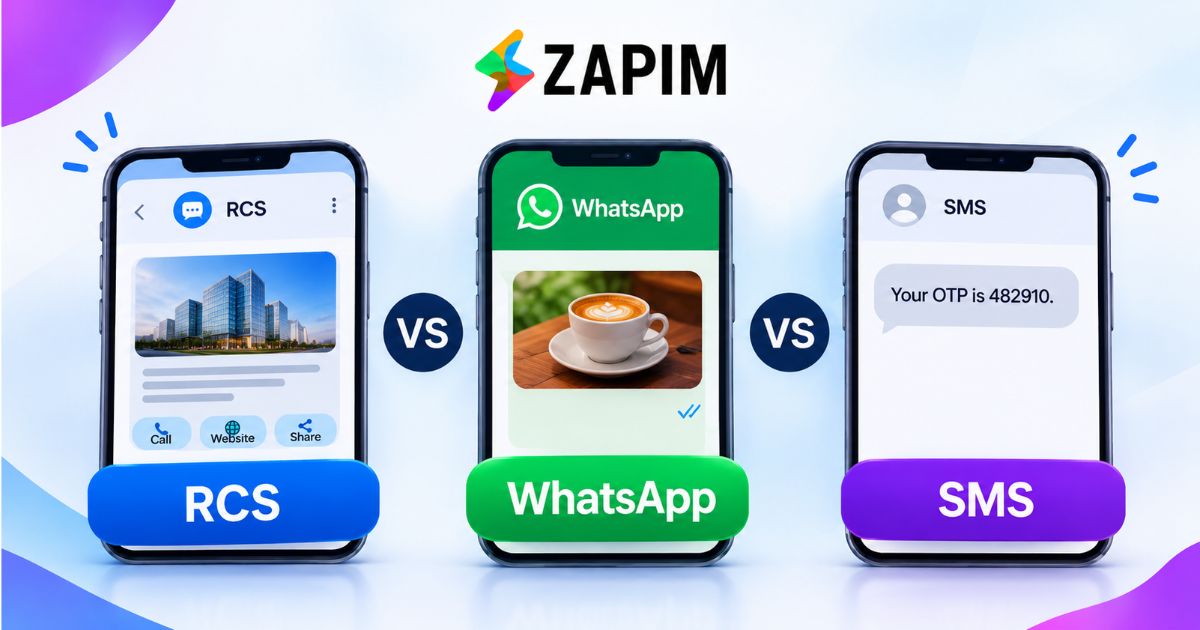
RCS vs WhatsApp vs SMS: Which Business Messaging Channel Should You Choose in 2026?
Quick Answer
SMS is best for OTPs, payment alerts, and short updates. WhatsApp helps businesses chat with customers and answer questions. RCS supports images, product cards, and action buttons on compatible devices. The best channel depends on your audience, budget, and goals. Businesses can also use all three channels for different needs.
Introduction
Businesses send messages every day. They share order updates, payment alerts, offers, and reminders. These messages keep customers informed. But choosing the right messaging channel can be difficult.
The three main options are SMS, WhatsApp, and RCS. Each serves a different purpose. SMS sends simple text messages, while WhatsApp supports customer conversations. RCS delivers more visual and interactive messaging experiences, with RCS Service Providers helping businesses implement and manage these advanced communication solutions.
The right choice depends on your business goals. Also consider your customers, budget, and message type.
This guide explains the differences in simple terms. It will help you choose the right business messaging channel in 2026.
What is RCS Business Messaging?
RCS stands for Rich Communication Services. It adds useful features to supported messaging apps.
Unlike SMS, RCS can include images, videos, product cards, and action buttons. Businesses can also use verified brand profiles where supported.
For example, a clothing store can share a product image with a “Shop Now” button. A delivery company can send an update with a “Track Order” button.
These features make messages more useful. Customers can view details and take action from the message.
RCS works well for product offers, promotions, and interactive updates. However, it does not work on every phone or network. Support depends on the device, messaging app, carrier, and provider.
Before starting a campaign, check whether your customers can receive RCS messages. Also ask if SMS fallback is available when RCS does not work.
What Is WhatsApp Business API?
The WhatsApp Business API helps businesses send and receive messages through their business systems. It helps companies manage many customer conversations.
Businesses can use it for order updates, booking reminders, customer support, and approved offers. It can also connect with chatbots and customer support tools.
For example, a customer may receive an order confirmation on WhatsApp. If they have a question, they can reply in the same chat. The support team can then help them.
The WhatsApp Business API helps companies manage chats at scale. It can also automate replies to common questions.
Businesses must follow WhatsApp’s policies and consent rules. They should not send unwanted messages. Before starting a campaign, check the current rules and costs.
What Is SMS for Business?
SMS is a text messaging service that works on almost every mobile phone. Customers do not need a separate app to receive a standard SMS. They also do not need mobile data.
Businesses use SMS for:
- OTPs and login codes.
- Payment alerts.
- Order confirmations.
- Delivery updates.
- Appointment reminders.
A Bulk SMS Service helps businesses send many text messages through a platform or API.
For example, a bank can send payment alerts to customers. An online store can share delivery updates with many buyers.
SMS is simple and reliable for short updates. However, it offers fewer visual features than RCS or WhatsApp. Long messages may also use more than one message segment.
In India, commercial SMS must follow applicable telecom rules. These may include DLT registration and approved message templates. Check the rules before starting a campaign.
RCS vs WhatsApp vs SMS: Quick Comparison
|
Feature |
RCS |
WhatsApp Business API |
SMS |
|
Main Benefit |
Visual, branded messages |
Customer conversations |
Broad mobile reach |
|
Content |
Images, cards, buttons |
Text, media, and interactive features |
Mainly texts and links |
|
App needed |
Depends on device support |
WhatsApp is required |
No separate app |
|
Internet |
Needed for RCS features |
Required |
Not needed for standard SMS |
|
Best Use |
Interactive Campaigns |
Support and engagement |
OTPs and alerts |
|
Pricing |
Varies by provider |
Meta charges and provider fees may apply |
Provider rates and message length |
|
Main limit |
Coverage may vary |
Customers needs WhatsApp |
Few visual features |
No channel is best for every business. Compare your customers, message type, and budget before making a choice.
RCS vs SMS: Which One Should You Choose?
The main difference is the message experience. SMS sends plain text. It works on most mobile phones and doesn't require mobile data.
RCS offers more features. Businesses can add images, product cards, and action buttons. Customers can view details and take action without relying only on text links.
Choose SMS when you need to:
- Send OTPs and login codes.
- Share payment and account alerts.
- Provide short delivery updates.
- Reach customers on many types of phones.
Choose RCS when you want to:
- Show products through images.
- Share interactive offers.
- Send branded messages.
- Add buttons that guide customers.
RCS is useful when a message needs to attract attention. SMS is better for short and essential updates.
Some providers offer SMS fallback when RCS is unavailable. Ask whether this feature is included and whether extra charges apply.
RCS vs WhatsApp: What Is the Difference?
RCS and WhatsApp both support rich content. However, they work differently.
RCS uses supported messaging apps and networks. It can show branded messages, product cards, and action buttons.
WhatsApp works through the WhatsApp Business API. It is useful when customers need to ask questions or continue a conversation. It can also support automated replies and customer service.
Choose RCS when you want to present products or offers visually. Choose WhatsApp when customers may need help before or after a purchase.
Businesses can use both channels together. For example, a store can share a product offer through RCS. Customers can then use WhatsApp to ask questions or get support with their order.
Understanding WhatsApp Business API Pricing
WhatsApp Business API Pricing may include Meta’s charges from the service provider. The final cost can depend on the message category, recipient market, and provider plan.
Rates and rules can change. Always check current prices before setting your budget.
Ask these questions before choosing a provider:
- Are Meta’s charges included?
- Is there a setup fee?
- Is a monthly fee required?
- Are chatbots and automation included?
- Do integrations cost extra?
- Are reports and technical support provided?
Compare the total cost, not just the advertised rate. Also check whether the plan fits your message volume.
A clear pricing plan helps you control spending. It also makes it easier to compare providers.
When Should You Use WhatsApp Bulk Messaging?
WhatsApp Bulk Messaging helps businesses send messages to many customers through supported tools. It can be useful for reminders, order updates, and relevant offers.
Common uses include:
- Sharing offers with interested customers.
- Sending appointment reminders.
- Providing order and delivery updates.
- Following up with potential customers.
- Sharing approved business notifications.
Send messages that matter to your customers. For example, a clothing store can share new arrivals with people interested in those products.
Avoid sending the same message to everyone. Too many unwanted messages can reduce trust.
Businesses must follow WhatsApp’s policies and consent requirements. Avoid purchased contact lists and respect customer choices. Make it easy for customers to manage their communication preferences.
How to Choose the Right RCS Service Providers
Reliable RCS Service Providers can help you set up campaigns and track results. However, features and coverage may vary. Compare providers before making a decision.
Check these points:
- Coverage: Check supported devices, networks, and regions.
- Integration: Make sure the platform works with your systems.
- Brand verification: Ask about profile setup and approval.
- SMS fallback: Check whether SMS is available when RCS fails.
- Reports: Look for delivery, click, and engagement data.
- Support: Ask how technical problems are handled.
- Pricing: Request a clear list of all charges.
Do not choose a provider based on price alone. Check whether its features meet your needs.
Start with a small campaign. Review the results and improve your messages before increasing the volume.
How Indian Businesses Can Use All Three Channels
Businesses can use SMS, WhatsApp, and RCS for different tasks.
Imagine an online store in Delhi NCR. It wants to confirm orders, promote products, and answer customer questions.
It could use:
- SMS for OTPs and payment alerts.
- RCS for product cards and interactive offers where supported.
- WhatsApp for customer questions and order support.
A clinic could use SMS for appointment reminders and WhatsApp for follow-up questions. A travel company could use SMS for booking codes and WhatsApp for customer support.
The right mix depends on the business and its customers.
Track clicks, replies, completed actions, and total costs. Delivery rates alone do not show whether a campaign is successful.
How Zapim Can Support Your Messaging Strategy
Zapim provides information about different business messaging solutions. Businesses can explore its RCS, WhatsApp, and SMS services, including RCS for Business, which enables brands to deliver rich, interactive, and engaging customer messages.
Before choosing a solution, consider your audience, message volume, budget, and integration needs. Ask for current pricing and confirm which features are included.
Choose tools that solve real communication needs. You don't need every feature if it doesn't help your business.
Conclusion
RCS, WhatsApp, and SMS each serve a different purpose. SMS works well for important alerts. WhatsApp supports customer chats and service. RCS offers visual and interactive messages on supported devices.
The best choice depends on your audience, budget, and goals. You can also combine all three channels to meet different needs.
If you are comparing RCS Service Providers, check coverage, integration, support, reports, and pricing. Explore Zapim’s RCS, WhatsApp, and SMS services to find the right option for your business.
Frequently Asked Questions
1. Which is better for business: RCS, WhatsApp, or SMS?
SMS is useful for OTPs and alerts. WhatsApp is good for customer chats. RCS suits visual messages on supported devices.
2. Is RCS better than SMS?
RCS supports images and buttons. SMS works on more phones and doesn't require mobile data. The best option depends on your audience.
3. What is the WhatsApp Business API used for?
It helps businesses manage chats, send approved messages, automate updates, and connect support tools.
4. How much does WhatsApp Business API cost in India?
Costs depend on current Meta charges, message categories, recipient markets, and provider fees. Check current prices before budgeting.
5. What is WhatsApp Bulk Messaging?
It means sending business messages to many people through supported tools while following WhatsApp’s policies and consent rules.
6. How do I choose RCS Service Providers?
Check coverage, integration, verification, pricing, reports, and support. Also ask whether SMS fallback is available.
7. Can businesses use RCS and SMS together?
Yes. Some providers support SMS fallback when RCS is unavailable. Confirm the feature and any extra charges.
8. Which messaging channel is best for Indian businesses?
Use SMS for important alerts, WhatsApp for customer chats, and RCS for interactive messages where supported.